

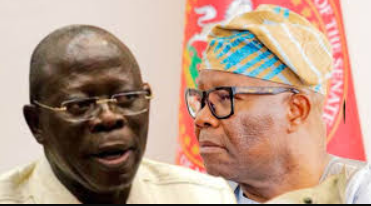
A new political storm is brewing in Abuja after Senator Adams Oshiomhole made a serious allegation involving Senate President Godswill Akpabio and appointments within the Nigerian National Petroleum Company Limited (NNPC).
The accusation is already attracting attention because it touches on an issue that frustrates many Nigerians: whether powerful connections matter more than merit when it comes to securing top jobs in public institutions.
The Facts Behind the Allegation
Former Edo State governor and senator, Adams Oshiomhole, has alleged that Senate President Godswill Akpabio’s daughter obtained a desirable position within the NNPC without going through the standard recruitment process.
Oshiomhole made the claim during an appearance on Seun Okinbaloye’s Mic On Podcast while discussing developments surrounding the NNPC, including the controversy involving former Group Chief Executive Officer Mele Kyari.
According to Oshiomhole, information available to him suggested that Akpabio’s daughter was appointed outside the normal hiring procedures. He further claimed that nepotism had become deeply rooted within the national oil company, alleging that relatives of influential individuals had been employed across various departments.
However, Oshiomhole acknowledged that family members of public officials have the right to work in government agencies if they are qualified and hired through proper procedures.
At the time of the allegation, no evidence was publicly presented to support the claim, and no official response had been issued from Akpabio or the NNPC regarding the accusation.
Why This Matters
The controversy strikes at the heart of a long-standing concern among Nigerians.
For years, complaints about favoritism, political influence, and lack of transparency in public sector recruitment have fueled public distrust. Many young Nigerians believe opportunities are often reserved for those with powerful connections rather than those with the strongest qualifications.
That is why allegations involving appointments in a major national institution like the NNPC tend to attract intense public interest.
The issue is also politically significant because it involves two influential figures within Nigeria’s ruling establishment. Any public disagreement between senior political actors can quickly develop into a wider debate about governance, accountability, and institutional integrity.
If such claims are proven, they could raise serious questions about recruitment standards. If they are not proven, they could further intensify political tensions and accusations ahead of future electoral contests.
Public Reaction and What Comes Next
Social media users are already likely to be divided.
Some Nigerians may view Oshiomhole’s comments as evidence of what they believe happens behind closed doors in government agencies. Others may argue that allegations alone are not enough and that concrete proof should be provided before conclusions are drawn.
Political observers will now be watching for possible responses from Akpabio, the NNPC, or other government officials. There may also be calls for greater transparency regarding recruitment practices within public institutions.
The next major development will likely depend on whether evidence emerges to support the allegations or whether the claims become part of a broader political battle within the country’s power circles.
If influential politicians continue accusing one another of favoritism and backdoor appointments, could that finally push public institutions toward greater transparency, or will Nigerians remain skeptical about how top government jobs are filled?
