

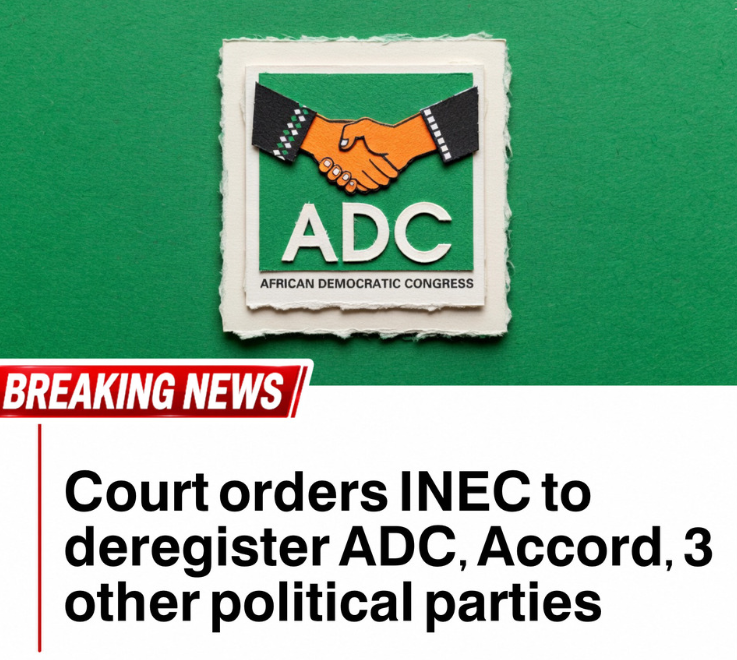
Nigeria’s political landscape could be heading for a major shake-up after a court ordered the deregistration of five political parties, including the African Democratic Congress (ADC). The ruling has immediately sparked questions about who will be allowed to contest future elections and how opposition politics could be affected ahead of 2027.
For many Nigerians, this is more than a legal dispute. It is a development that could influence political alliances, campaign plans, and the choices available to voters in the next general election.
The Facts Behind the Court Decision
The Federal High Court in Abuja directed the Independent National Electoral Commission (INEC) to deregister five political parties.
The affected parties are the African Democratic Congress (ADC), Action Peoples Party (APP), Action Alliance (AA), Accord Party (AP), and Zenith Labour Party (ZLP).
Justice Peter Lifu delivered the judgment after hearing a suit filed by the National Forum of Former Legislators.
The group argued that the parties failed to meet constitutional requirements needed to remain registered. According to the case presented before the court, political parties are expected to achieve specific electoral benchmarks, including winning a certain percentage of votes or securing elective positions at different levels of government.
The plaintiffs maintained that the affected parties performed poorly during the 2023 general elections and subsequent by-elections, making their continued registration inconsistent with constitutional provisions.
The court agreed and ordered INEC to proceed with deregistration.
Why This Matters
This ruling has the potential to reshape political calculations ahead of the 2027 elections.
Smaller political parties often serve as alternative platforms for politicians seeking office outside the country’s dominant parties. If the judgment stands, several politicians may be forced to rethink their political future and explore new alliances.
The decision also reignites a long-running debate about whether Nigeria should have fewer political parties. Supporters of stricter deregistration rules argue that parties should demonstrate meaningful electoral support before retaining official recognition.
Critics, however, may see the move as reducing political diversity and limiting options available to voters.
Another major issue is the possible impact on opposition figures and aspirants who may have been considering any of the affected parties as vehicles for future campaigns.
Public Reaction and What Comes Next
Political observers and social media users are likely to view the judgment through different lenses.
Some Nigerians may welcome the decision as a step toward reducing the number of inactive political parties. Others may worry that it could weaken political competition and make it harder for smaller groups to challenge established political forces.
Attention will now shift to INEC and the affected parties. Appeals are likely to become the next major battleground, especially given the high stakes involved before preparations for the 2027 elections gather momentum.
The biggest question remains whether the ruling will survive further legal challenges or become a turning point that permanently changes Nigeria’s political map.
If more political parties face similar scrutiny in the future, would that strengthen Nigeria’s democracy or reduce the political choices available to voters?
